.png)

The Pride of Maharashtra: A Timeless Journey Through Warli Art

Introduction: The Spirit of Maharashtra
On the occasion of Maharashtra Day, we celebrate more than the formation of a state—we celebrate a spirit. A spirit shaped by resilience, community, and a cultural depth that extends far beyond what meets the eye.
While Maharashtra is often seen through its bustling cities and modern infrastructure, its true essence lies quietly in its villages, forests, and indigenous communities. It lives in traditions that have been preserved not in books, but in practice—in rituals, in everyday life, and in art forms that continue to speak across generations.
Among these, Warli art stands as one of the most profound and authentic expressions of Maharashtra’s cultural identity.
The Warli People: Keepers of a Living Tradition
Deep within the Sahyadri ranges of Maharashtra lives the Warli tribe—one of India’s oldest indigenous communities. Their lives are deeply intertwined with nature, guided by seasons, agricultural cycles, and a strong sense of collective living.
For centuries, their knowledge systems have been passed down without a written language. Instead, they rely on memory, ritual, and visual expression.
Warli paintings, created on the mud walls of their homes, became a powerful medium to document life—marking significant events such as weddings, harvests, and festivals.
Traditionally practiced by women, this art form was never created for display. It existed as a part of life itself—a shared language through which the community expressed its beliefs, rhythms, and connection with the natural world.
The Geometry of Nature: Simplicity with Depth
At first glance, Warli art appears simple—composed of basic shapes and minimal detail. Yet within this simplicity lies a sophisticated visual language.
The circle represents the sun and moon—the eternal cycle of time.
The triangle reflects mountains, trees, and the dynamic elements of nature. The square, often referred to as the chowk, signifies a sacred space—typically at the center of important compositions.
Human figures are created using two triangles joined at their tips, forming a delicate balance that symbolizes harmony between humans and nature.
Warli as a Celebration of Community
Warli art does not highlight individuals—it celebrates the collective.

Scenes of farming, hunting, cooking, and dancing come together to form a visual narrative of shared existence. One of the most iconic motifs is the Tarpa dance, where figures move in a circular rhythm around a central musician playing the traditional Warli instrument, the Tarpa.
This living tradition continues to thrive through artists like Bhiklya Ladakya Dhinda, who was recently honoured with the Padma Shri for his lifelong dedication to preserving the Tarpa tradition. His recognition reflects the enduring strength of Maharashtra’s tribal cultural heritage.
The Artists Behind the Legacy
While Warli art has always been a community practice, several artists have played a crucial role in bringing it wider recognition. Among them, Jivya Soma Mashe stands out for transforming Warli painting from ritual wall art into a globally recognized art form.
Other notable contributors include:
Balu Mashe
Sadashiv Mashe
Shivram Gojre
Alongside these names are countless artisans—often unnamed—who continue to sustain and pass on this tradition and are instrumental in keeping it alive.
Sustainability: Rooted in Practice, Not Positioning
Sustainability, in the context of Warli art, is not a concept that was adopted—it is a way of life that has always existed within the community.
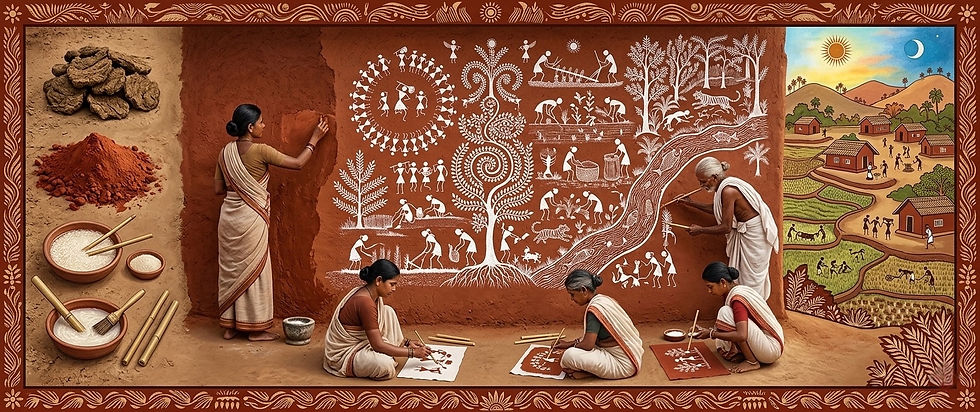
Traditionally, Warli paintings are created on walls prepared using a mixture of cow dung or geru (red earth clay), giving them their distinctive earthy backdrop. The paint itself is made from rice paste, applied using simple tools like bamboo sticks or handmade brushes. There is no separation between material and environment—every element comes from the land and returns to it.
Even today, as the art transitions onto paper or fabric, this philosophy continues to influence its practice. The restraint in colour, the absence of excess, and the reliance on natural textures reflect a system that is inherently balanced.
Warli does not try to be sustainable—it simply is.
From Practice to Platform: Expanding the Language of Warli
One of the most important questions today is not whether Warli art should evolve—but how it can evolve without losing its essence.
At Truly Tribal, our approach has been to work with the art form—exploring how it can move across new surfaces such as handmade paper, handwoven cotton, wood, and contemporary formats, while retaining its storytelling integrity.
This also involves reimagining how Warli can be represented—not just as wall art, but across products such as textiles, corporate gifting, and tabletop décor. Each creation becomes an extension of the original narrative—only now, it travels further.
Building Back the Ecosystem: When Demand Creates Continuity
One of the most defining shifts in recent years has been understanding how demand directly and positively impacts craft, and how the modern corporate and business world can contribute to this deeply rooted practice.
What may appear as a single large order externally often translates into something far more meaningful on the ground. An order of over 45,000 Warli art products resulted in sustained work for 50+ artisans and led to the formation of new clusters in remote regions. This is where craft moves beyond visibility and into viability. It enables:
Structured, continuous engagement
Revival of skills in regions where the craft was fading
The return of artisans to their practice
The emergence of collective production systems
At Truly Tribal, this understanding has shaped our approach. Our work focuses not just on creating products, but on rebuilding ecosystems around the craft.This includes:
Identifying and collaborating with existing artisan groups within Warli communities
Supporting the development of new clusters where the craft is at risk
Creating consistent engagement so the art is practiced sustainably, not seasonally
Encouraging artisans—especially younger generations—to return to the craft with dignity and purpose
In parallel, we have also worked towards expanding participation within these ecosystems. By building and training a community of underprivileged women in Warli art, we have enabled more individuals to become part of the production process—contributing to larger orders while building independent sources of livelihood.
Because in crafts like Warli, survival does not come from appreciation alone—it comes from continuity of work, strength of community, and relevance in the present.
And sometimes, what begins as a single order becomes the foundation of something much larger—an ecosystem that sustains both the art and the people behind it. Read more about this in our earlier blog:
Deepening Understanding: Beyond the Surface
Warli art is often appreciated for its visual appeal—but its true depth lies in understanding the meaning behind its forms.

Over time, we have also focused on building awareness around:
The significance of motifs and compositions
The structure of traditional storytelling within Warli
The preparation of surfaces and materials
The transition from ritual art to contemporary formats
For those who wish to explore this further, we have documented parts of this journey through our earlier writings. Because the more one understands Warli, the more one begins to see that its simplicity is layered with meaning. To explore this further, you can read:
Understanding Warli Motifs and Their Meanings
The Process of Preparing a Warli Canvas
Warli Canvas: Then & Now
Exploring Themes in Warli Art: From Tradition to Modern Contexts
Exploring Themes in Warli Art:
Taking Maharashtra to the World—With Its Story Intact
As Warli art finds its place in contemporary spaces—from homes to corporate environments—it carries more than just visual identity. It carries context. The challenge is not just to take Warli to the world, but to ensure that when it travels, it does so with its story intact.
This Maharashtra Day, as we celebrate the identity of the state, Warli art offers a reminder of where that identity truly comes from— from communities that have lived in balance with nature, from traditions that have been sustained through practice, not preservation alone, and from art forms that continue to evolve without losing their essence.
As an organization, our role has been to participate in this journey—to create relevance, build continuity, and ensure that this art form continues to find its place in the present.
Because Warli is not just something to be admired. It is something to be understood, supported, and carried forward.


Comments