.png)

How a Large Order Impacts Livelihood in Far-Flung Villages: A Warli Art Story

In India’s far-flung villages, art is not created in studios or galleries. It is born in courtyards, under tin roofs, beside farming fields and forest edges. It lives in the hands of artisans who inherit not just patterns, but responsibility — the responsibility to keep a centuries-old tradition alive, often with very limited means.
Warli art is one such living tradition.
Rooted in the tribal belts of Maharashtra, Warli art has always been a visual language of life — celebrating nature, community, seasons, and harmony. Yet, despite its global recognition today, the artisans behind it continue to face uncertainty. Irregular demand, seasonal income, and the pressure to migrate for daily-wage labour have slowly threatened the continuity of this art form.
This is where the story of how a large order impacts livelihood in far-flung villages truly begins.
When a Corporate Order Travels Beyond Boardrooms
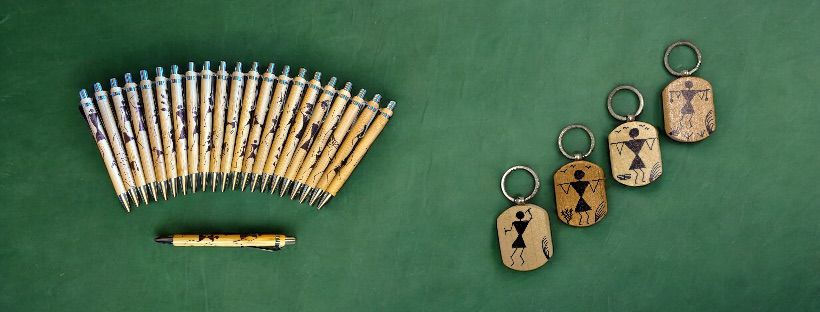
For Brand Talk, the requirement was straightforward and well-defined:
45,000+ Wooden Warli Art Pens
45,000+ Wooden Warli Art Keychains
On paper, it was a large corporate gifting order with timelines, quantities, and quality benchmarks. But once this order moved through Truly Tribal’s artisan ecosystem, it transformed into something far more powerful.
What seemed like a bulk requirement became months of assured work for Warli artisans living in remote villages — places where access to consistent employment is rare, and opportunities are often limited by geography.
This is how a large order impacts livelihood in far-flung villages — by reaching places where economic systems often don’t.
From Uncertainty to Stability in Artisan Livelihoods
In many Warli villages, artisans practice their art alongside farming or daily-wage labour. The lack of consistent orders forces families into financial uncertainty. Skilled artisans are often compelled to abandon their craft temporarily — not because they want to, but because survival demands it.
This large-scale order changed that cycle.
The volume and continuity of work ensured:
Predictable income over an extended period
Reduced dependence on seasonal labour
The dignity of earning through one’s own traditional skill
More than 50 Warli artisans received direct livelihood through this single project. For many households, this meant timely school fees, stable household expenses, and freedom from short-term migration.
For the artisans, it meant something even deeper — the reassurance that their art still holds value in the modern world.
The Birth of New Warli Artisan Clusters

As production scaled, the impact expanded beyond individual livelihoods.
To meet the volume and timelines responsibly, two new Warli artisan clusters were developed. These clusters were not just production units — they became spaces of collaboration, learning, and collective confidence.
Senior artisans mentored younger ones. Families worked together. Skills were passed on organically — not as theory, but as lived practice.
Young artisans who were earlier unsure about pursuing Warli art began to see a future in it. Children watched their parents’ work being respected, packaged, and sent to cities and offices they had only heard of.
This is how a large order impacts livelihood in far-flung villages — by creating ecosystems, not just employment.
When Art Becomes a Source of Pride Again

One of the most understated yet powerful outcomes of this order was restored confidence.
For years, many artisans have grown up hearing that traditional art cannot sustain modern life. This belief silently discourages the next generation from learning or continuing their inherited craft.
This project challenged that narrative.
Seeing thousands of Warli pens and keychains being created, quality-checked, and dispatched at scale instilled pride — not just in the artisans, but in their families. The art was no longer a side income; it became a respected profession.
This confidence is what keeps art alive across generations.
Products That Travel, Impact That Stays
While the Warli pens and keychains travelled across cities — placed on corporate desks, gifted at conferences, and shared among professionals — their impact remained rooted in the villages.
Every product carried:
Assured wages
Strengthened artisan communities
Reduced economic vulnerability
Renewed belief in traditional knowledge
This is how a large order impacts livelihood in far-flung villages — quietly, deeply, and sustainably.
A Larger Message for Decision-Makers
This story is not unique to Warli art alone.
It reflects what is possible when:
Corporates choose Indian art consciously
Procurement decisions consider impact, not just price
Gifting becomes a medium of empowerment
Large orders have power. When directed thoughtfully, they can create employment, strengthen rural economies, and ensure that India’s living traditions do not fade into memory.
Truly Tribal’s Role

At Truly Tribal, our role is not just to supply products; it's to provide a unique experience. It is to act as a bridge — connecting modern institutions with artisan communities in a way that is ethical, scalable, and respectful.
We believe that:
Indian art deserves consistent demand
Artisans deserve dignity and stability
Heritage survives best when it sustains livelihoods
This Warli art story stands as a reminder of what is possible when scale meets sensitivity.
In Closing
This is how a large order impacts livelihoods in far-flung villages — not through charity, but through opportunity. Not through sympathy, but through respect. Not through words, but through work.
When Indian art is chosen at scale, it does more than decorate desks. It builds futures, strengthens communities, and keeps traditions alive — one order at a time.


Comments